
Author Archive

[Huggles web server]

Posted in Random Stuff, Tales from the grind-stone on February 9th, 2008 by MrCranky

And we’re back! By which I assume that the scheduled down-time while our server was migrated to another data centre has been completed without a hitch. I did intend to post here that it was going to happen, but it did in fact catch me by surprise because I thought it was supposed to be last Friday.

My only real mistake was to start reading some of the comments on the Dreamhost status blog regarding the move. Despite the fact that they were open and up front about the move – giving warning on the status page as well as by email more than 2 weeks in advance, they are still customers who feel free to bitch and moan in a most personal and horrific way. Seriously – this sort of stuff really makes me sad to see the sort of attitudes people have these days. Nowhere in the Dreamhost sales pitch does it imply that your 8 USD a month was somehow buying you a service that would be up for absolutely 100% of the time, and yet these folk think that even the best handled server downtime is grounds for some personal abuse. If I were running Dreamhost, I wouldn’t hesitate to respond to any of those “this is unacceptable” comments with “Oh I’m sorry, here’s a refund for the rest of your service, don’t let the door hit you in the arse on the way out”.

Anyway, trust in Dreamhost’s tech staff aside, my paranoia has been in high overdrive recently, so I had taken this opportunity to double check that our nightly backup procedure was working properly – and I was pleased to find it had. Which means that, should Dreamhost fall over at a critical juncture, we can fall back on our local mirror of the server and only lose work done since the previous night. Not that I’m expecting DH to fall over – they seem to have gotten on top of their random downtime issues, and since I’ve been tracking it with an external tool we’ve only been off-line for 4 hours out of the last 6 months, and no more than 2 hours in a single outage. Why don’t we just host our work locally and use an off-site backup? Well, we do a lot of collaboration with other client, and upstream bandwidth from the office is rather precious. That and the fact that Dreamhost already have quite a few mechanisms in place to restore connection and hardware problems, so they’re probably far more reliable than our local server machines anyway.

Of course, even that’s not enough for us, paranoia wise – not only do we have the primary copies in a well maintained place off site, and secondary copies in the office, we also keep physical (DVD) copies of the repositories in yet another location. Of course the first two are all automated, but the third requires me to actually go over and poke the office server to make a DVD and take it away with me. Unfortunately my attempts to train the local squirrels to do automate the process for me have been unsuccessful, but I have high hopes…

Morning of the walking dead

Posted in Industry Rants, Links from the In-tar-web, Tales from the grind-stone on January 28th, 2008 by MrCranky

Or so it feels – I can barely keep my eyes open. A combination of a very long couple of weeks and a cat who my girlfriend has somehow trained into believing that scratching on our bedroom door from 3:30 am onwards is a good way to get food has left me more than a bit bleary. And today was the day that I was supposed to try out some decaffeinated filter coffee in the machine. Yes, I realise it’s breaking the cardinal rule of programming, but I can’t seem to get the balance right between coffee that’s so strong it makes my teeth jump by mid-afternoon and weak watery rubbish that tastes of nothing. Anyway, I just can’t see that happening, so it’ll be the regular coffee today, at least until I can perk up a bit.
We kick off on the second of our work for hire jobs this morning, so now we are splitting our time between jobs. Not many details to share as yet because I haven’t cleared it with our clients, but I hope to rectify that soon and have something to say here about it. Still not heard back from our licensed developer application yet, but I’m putting that down to applying over the holiday season introducing an extra delay. Admittedly, we’d have little time to do any solid work on it right now, but I’m hoping that things will settle into a more forgiving routine soon.

Interesting piece here with quotes from Jon Hare (ex Sensible Software) that popped up in the Google Alerts for my name (yes I know, how vain is it to be searching for myself, but it throws up the ‘other’ Chris Chapman as well). Two major points I agree with:

1) the quality of programming has dropped with the move to larger teams; I think that is somewhat inevitable though, you just can’t sustain the same team dynamics that you get with less than a dozen team members. Personally I think the approach of scaling up not by having a larger team, but by using multiple small (<12) teams has merit. Of course, the ability to do that hinges on being able to break up the development effort into tangible pieces that can be tackled by the teams.

2) British developers are continually being forced to ‘globalise’ (i.e. Americanise) their products in order to try and maximise sales in the North American market. But to do that, I think we are selling ourselves short – not just in terms of making the most of the British sense of humour, but also the culture we have here. There are a lot of stories to be told, and game ideas which could only come from a British team – but I think they are being passed over because the publishers think that they won’t sell in the broader marketplace. I’m very hopeful that reduced barriers to market from downloadable content will help the balance shift back towards interesting titles (and not just be an excuse for more shovel-ware)

Working from home

Posted in Tales from the grind-stone on January 18th, 2008 by MrCranky

Pros:

  • 40 minutes saved walking to and from office = 40 minutes extra work time
  • Hot tasty food for lunch instead of just sandwiches
  • Can use break time to go out and do much needed food shopping

Cons:

  • Cats alternating between walking on my keyboard while I’m typing, and lying nearby looking grumpily at me because I’m not playing with and/or feeding them
  • Harder to concentrate (see point about cats)

Well, I think it’s about even on those. Never mind – back in the office tomorrow, so Bertie won’t starve to death in my absence. Working on a Saturday you say? Well that’s down to the sheer volume of work we’ve got on at the moment – the quiet time from before Christmas has been replaced by a deluge, and never one to shy from a bit of hard graft, I’m working a bit extra. I’m pretty confident we’ll settle back into a normal routine once both contracts are established, but for now it’s a little chaotic. Certainly I’m well aware of my previous rants about 9-5, Monday to Friday being the only sensible way to work, but at least temporarily I’m happy to push a little more if it means we deliver what the clients need.

Oh, and with regards to people who have emailed me lately about recruitment, I apologise for the delay in getting back to you, but paperwork has been somewhat shuffled to the back of the agenda. The situation will be rectified soon, I promise.

Brand New Year

Posted in Tales from the grind-stone on January 4th, 2008 by MrCranky

Hurrah – we survived another holiday season. No, not holiday season, that’s a bit too P.C. Christmas damn it! We survived another Christmas. It doesn’t just have to be for the Christians. It’s a holiday all about giving, receiving, and generally keeping the happy little consumer driven market afloat for another year. But I’m certainly not going to complain, as I came out of it with Super Mario Galaxy, Metroid 3 and Zelda – enough to keep me going for quite a while.

Regardless of how much Christmas is about buying of things these days, its still nice to see family, share a little happiness, and generally over-indulge a little. But once it (and the inevitable drinking too much on Hogmanay) are out of the way, I’m happy just to get back to some sort of routine. The new work that we were supposed to start before the holidays has finally kicked off, and we can get stuck in and get some solid stuff produced.

Work on our own technology has continued apace over the holidays though, and we’ve romped through the preliminary work we were doing to test out our engine. We’ll have to see how things balance out with external contracts, but I’m hopeful we won’t have to shelve our own work entirely, and can continue on prototyping our little game ideas to see what’s fun and where we can go with them.

Frosty morning

Posted in Industry Rants, Links from the In-tar-web on December 19th, 2007 by MrCranky

So as I look out, bleary-eyed, at the huge puffs of steam being vented past our window by the building’s boiler, I’m kind of sorry that moving to a proper office has meant that I can’t just stay at home in the nice warm flat and work from there on frosty days like these. Still, the office itself is warm enough, it’s just the trip to it that means I have to brave the icy conditions.

Just read an interesting article here on longer term planning with the Scrum methodology. Good stuff, but there’s still the big chasm of “how do we get the publisher to sign up to this”. Until the people paying the money are okay with the less detailed milestone definitions that come along with agile planning, there will continue to be issues. It’s all very well running teams on agile internally, but until there is a solid contractual way of satisfying the publisher’s need for security with the developer’s need for flexibility, there will still be problems. At the moment the milestones are defined fully at the start, but it’s a naive producer that doesn’t expect the content of those milestones to change. It’s at the developer’s disadvantage though – the contract states that they are bound to deliver what’s in the milestone list, and if they don’t the publisher is within their rights to cancel the project at their discretion. They generally won’t, but it’s a quick get out if they want it. Even if the publisher and the developer both know that the milestones have become meaningless, when they’re written into the contract it means that there needs to be a re-negotiation to fix them again.

Personally I think it’s far better to start out with a high level statement of intent – that the developer will be working on a particular title for the publisher, and that they will use their best efforts to deliver builds of acceptable quality. The regular delivery of those builds is part of the process, and the method of arbitration as to what is ‘acceptable’ is written into the contract as well. That way the publisher still retains the majority of the power (control over what they deem acceptable), but they can’t use that control to avoid their responsibilities to allow the developer reasonable time to deliver something acceptable.

Applying for a job

Posted in Random Stuff on December 10th, 2007 by MrCranky

Okay, so we have had our Jobs page up for a while now, but ever since we started I’ve had a continual stream of emailed applications from potential employees. Some are impressive, some are not, but this post isn’t directed at any of them in particular. It’s intended as a guide to anyone else who is thinking of applying, so I’ll put a link to it on the right hand side.

First off, one of the biggest positive factors for a prospective employee is to show enthusiasm, both for developing games and for our company. We have this web-site and blog – it’s always been there, it’s fairly open. You could readily skim over everything on it in 5 minutes. So if your application clearly shows that you haven’t put in that small amount of effort, expect it to be either binned outright, or at least given short shrift. I make an effort to write a personal reply to every application, but the ones that annoy me get very little attention.

That point is at the core of why most applications that turn up in my in-box will fail, but I can sum the rest up in bullet points (most of which represent actual applications).

  1. DO understand that you’re applying for a games job, not just a ‘software’ or ‘IT’ job. Those who end up at games companies are primarily those who have a real passion for games, and that comes through readily in a good application.
  2. DON’T show ignorance of who we are and what we do. There are two of us, and we primarily do custom software development for other games studios. And yet we get applications which:
    1. talk about things like meshing with our organisation and looking forward to working in a large team.
    2. ask about jobs on our QA team
    3. are an impersonal email, even though the applicant worked with Pete and/or I at VIS
  3. DON’T send a generic “please I would like a job at your company” email. This includes:
    1. not mentioning our company at all
    2. not making sure the cover letter is appropriate to our company,
    3. the worst sin of all: sending the exact same email to every games developer in Scotland, and leaving all of those email addresses clearly visible in the To: line of the email!
  4. DO make sure your email and CV are free of spelling and grammar mistakes. Bad spelling and grammar says to me: “I’m so slack that I can’t be bothered to spend the 15 minutes it would take to look them over properly, despite the fact that I’m applying for a job that might be hugely important to the next few years of my life”. Frankly that’s not a person I’m necessarily keen to employ.

Paying attention to these details take a very short amount of time. There aren’t so many games companies out there that you can’t do them for every place you apply to. Personally I think for the potential reward (i.e. getting a job), they’re worth it. I’m sure more bad examples will appear in the future, so I’ll be keeping this post up to date.

Morning walks

Posted in Design Ideas, Tales from the grind-stone on December 3rd, 2007 by MrCranky

One of the good things about my new, doctor ordered, walk to the office in the morning is that it gives me 20 minutes or so of un-interrupted thinking time. I can’t do anything, no-one is asking me anything, so my mind is free to wander. This last week we’ve been brain-storming development ideas for our own games, finally. Engine and tools work is all very nice and satisfying, but without a clear end-goal, it’s not so productive.

So Pete and I had a proper idea generating session last week, and settled on a plan for making a small game as a first step. Well, second step really – as an intermediate step we’re making Pong, on the grounds that if the engine can do Pong, then it has all the components necessary to prototype game-play for our real first title.

The walk to work this morning though was about coming up with the concept for the real game though – we had some good game-play ideas, but nothing to tie them together into a game. I’m very much in favour of the few-short-paragraphs-of-exposition-then-into-the-game approach (think Super Mario Brothers), but we still need that exposition to give us something to focus the game style around. And a name for our protagonist always helps to coalesce ideas around as well.

Talking to the students

Posted in Industry Rants, Tales from the grind-stone on November 22nd, 2007 by MrCranky

So, since I didn’t have any pressing deadlines this week, I agreed to visit Paisley University and give a talk to the undergraduates there. Sorry, University of the West of Scotland:Paisley Campus (that’s soo got to bite them in the arse when it comes to their stationary). As an industry, I think we’ve somewhat dug ourselves into a hole in the past few years, by cutting back on hiring new people (and instead insisting on experience); now we’re facing a talent shortage, especially on the software side. We’ve seen the error of our ways now, and I see more adverts for graduates again, but that dry spell will no doubt have diminished our talent pool enough that it will take years to restore.

Nothing in the talk was particularly enlightening I’m sure, but I tried to impart a few of the things that you learn after your first years in the games industry: how to write a good CV, what it’s like working at smaller or larger companies, how to spot when your company’s about to go down the tubes. You know the sort of thing – stuff that no-one will tell you before you actually get your job, the sort of stuff you learn in the pub after work. I always remember talks from industry people when I was at Edinburgh, and they almost invariably had people saying “this is our company, look at how shiny it is, here’s our token recently hired graduate, listen to him tell you how shiny it is”. It was always about the potential for recruiting the graduates, and glossing over all the potential downsides.

So I tried to give a balanced view of the industry: a quick summation of the current state of the business, the potential likelihood that your employer will make you work unpaid overtime to ship the game, and the likelihood that the company folds while you’re still working there. Of course, I tried to stress the up-sides as well: the joy involved in making games, the rewards involved in shipping a title that people love. I hope it came out fairly balanced. Otherwise I must look like a bit of a numpty – why would I still be working in the games industry if the pros didn’t outweigh the cons?!

Anyway, if it didn’t come across in the talk, I’ll say it now – making games is great. It’s fun, it’s rewarding, and I find it hard to imagine how a job in the regular software industry would compare. Sure, there’s less money in games, but the non-monetary rewards are many.

Our pile of cards

Posted in Tales from the grind-stone on November 16th, 2007 by MrCranky

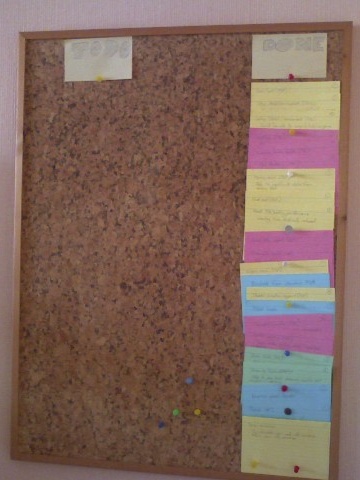
And so we finally wrapped up the latest work we’ve been doing for Add Knowledge yesterday, with a trip up to IC-CAVE at Abertay to drop off the PSP kits and an archive of the final software. Our Scrum board has been slowly shuffling cards over to the ‘done’ side, and now it’s all neat and tidy.

Job done!

Just in time for me to strip them all off and put them in a drawer. I should really look over our velocities and backlogs for the last part of the project, but for now I think it’s time to put it to one side. All in all we delivered what was asked for and on time, despite having to shuffle things around for a big demonstration in early October, so I think we can be satisfied with our recent efforts.

I think I’ll be spending the rest of the day making sure everything is tidied up after the deadline and that all the little bits of admin I’ve been putting off get done. Then, time for a relaxing weekend, and maybe some time finishing off Phoenix Wright 3.

Game Credits

Posted in Industry Rants, Links from the In-tar-web on November 6th, 2007 by MrCranky

Well, with the recent furore around Manhunt 2’s omission of certain developers from the credits of a game they clearly developed, the IGDA has put a reminder up about their work on establishing a Game Crediting Guide. It’s a fairly comprehensive guide now, and looking over it I agree with most of theĀ  stipulations within. I could argue that attribution of team roles to individuals is perhaps not necessary (especially when some developers fulfil many roles and so appear in the credits many times), but that’s probably a rare enough case not to worry about.

Proper credits is certainly a real issue though, as it’s a tangible benefit to your team. Being able to point to a good and/or successful title and say “I made that” is of real value for their sense of worth and their career long term. While not being credited isn’t the end of the world, there are enough unscrupulous people that claim credit for the work of others that not being credited when it is due is sufficient cause for doubt on the part of an interviewer.

Credits are, in my experience, usually knocked together at the end of the development process, and not thought about in advance. The list of people is usually drawn up quickly, and if there has been a lot of movement in and out of the team, people can easily be missed. It’s the producers job to maintain a credits list throughout development, detailing who worked on the title and for how long, and it’s not a chore which should be neglected.

Finally, my biggest bug-bear is with the ordering of the credits. I’m sorry, but the publishers, external producers and company management are not the most important people for a game. The director comes first, followed by the core team, and then the less involved parties. It might seem like a good idea to pander to the management or external partners, but you’re selling your team short if you don’t proclaim them loudly to be the most important part of the game.


Email: info@blackcompanystudios.co.uk
Black Company Studios Limited, The Melting Pot, 5 Rose Street, Edinburgh, EH2 2PR
Registered in Scotland (SC283017) VAT Reg. No.: 886 4592 64
Last modified: April 12 2020.